Keeping the outside lights on at night is a very common human instinct, fearing darkness as somehow alien to our being and survival. As we are learning, even the human species require deep darkness for both our physical and mental health to keep our circadian, or daily, cycles in synchrony with the turning of the Earth. We have increasingly lit our surroundings at night to the point that most urban dwellers have absolutely no idea what is going on over their heads, have never seen the Milky Way or a meteor or the Northern Lights. What a shame not to be able to see these wonders when they have been here long before us and will continue long after we are gone.
Research is revealing that over lit environments, known as light pollution, are harmful to wildlife as well as humans, from birds’ reproductive cycles to their migrations in fall and spring. Lack of total darkness confuses endocrine systems, disrupts breeding and sleep cycles, and in the fall and spring, cause lethal results when low-flying migrants collide with tall buildings that are lit at night from within or with bright outside uplighting. Some cities, such as Toronto are now working to reduce the carnage by encouraging tall building owners to turn off the lights during migration. By saving energy, the darkened buildings no longer act as enticing barriers that look like places for safe passage when lit. Keeping our urban skies dark also helps slow climate change, since it requires less energy.
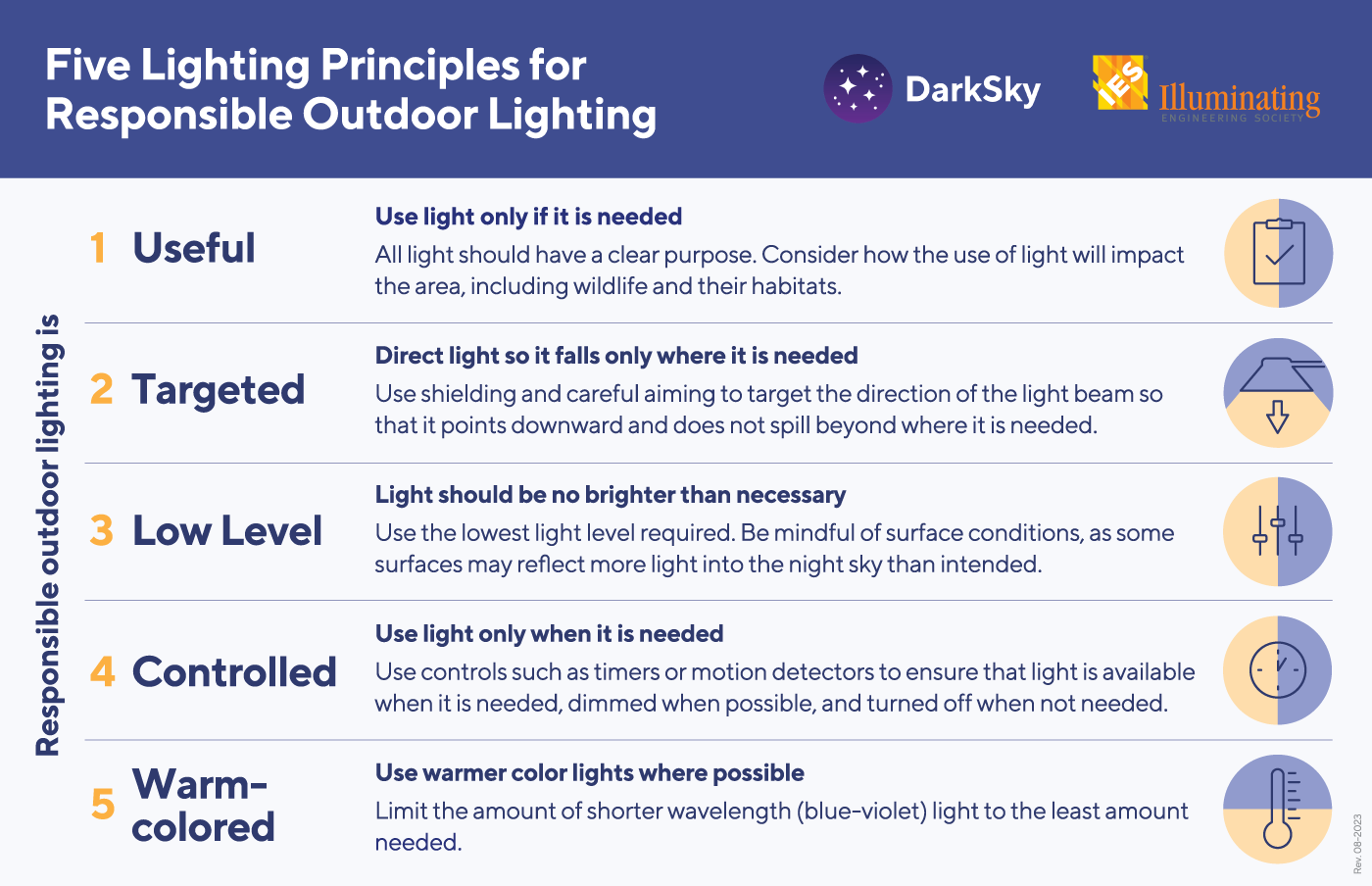
We can choose not to over light our own properties, both saving energy and providing a safer, more natural environment for those whose lives depend on darkness, including songbirds, fireflies, moths, owls and other wildlife. If you have bright outside lights, be sure that they are shaded so that their light focuses downward and not up or out. If not governed by automatic shutoff, such as with motion-detection lights, be sure to turn lights off, rather than leaving them on all night.
The Village of Lansing is committed to maintaining dark sky values as best it can but is not a Dark Sky certified community. To do that, we would have to have way less ambient light at night, which is created largely by our commercial and public areas- mall parking lots, banks, and roads, but also by our residential outside lighting as well. The Village still requires lighting plans for all new developments and works to reduce excess lighting by requiring and reviewing lighting plans, not allowing exterior uplighting, preventing light trespass and discouraging what it considers to be excessive lighting where more modest means would work well.
The Dark Sky website has a wealth of information about the impacts of light pollution and the dark sky principles: https://darksky.org/resources/what-is-light-pollution/
https://darksky.org/app/uploads/2023/08/Five-Lighting-Principles-08-2023.png